Australia could be in for a hot, dry El Niño year according to early weather signs.
The Pacific region is currently in a La Niña phase, characterised by cooler and wetter weather conditions.
This began in spring 2025, but Weatherzone reports those conditions are now weakening and expected to decay further.
READ MORE: Father's mystery disappearance now considered suspicious
The Pacific does not necessarily swing between El Niño and La Niña, but can remain in a neutral state, which is expected this autumn.
"The transition to a neutral El Niño-Southern Oscillation (ENSO) state in the Pacific Ocean this autumn opens the door for a potential switch to El Niño later this year," Weatherzone reported.
"While this is not guaranteed, it is not uncommon for El Niño to follow La Niña after the tropical Pacific Ocean passes through a neutral phase in the middle of the year."
READ MORE: David sold his home for $2 after 'traumatic' new rule forced him out

The Bureau of Meteorology currently rates the chances of an El Niño developing in the second half of the year at about 90 per cent, though other models offer lower odds.
"One important thing to note about the current El Niño forecasts is that predictions made at this time of year are less reliable than forecasts initiated after the southern hemisphere's autumn," Weatherzone said.
"This period of reduced certainty is known as the 'autumn predictability barrier', and it means that forecasters should have a clearer idea about the likelihood of El Niño as we get closer to winter in the southern hemisphere."
READ MORE: Oscar-winning screen legend Robert Duvall dead at 95

Weatherzone reported there were also signs of a positive Indian Ocean Dipole emerging later in the year.
The IOD affects weather on Australia's west coast, while the El Niño/La Niña systems affect weather in the east.
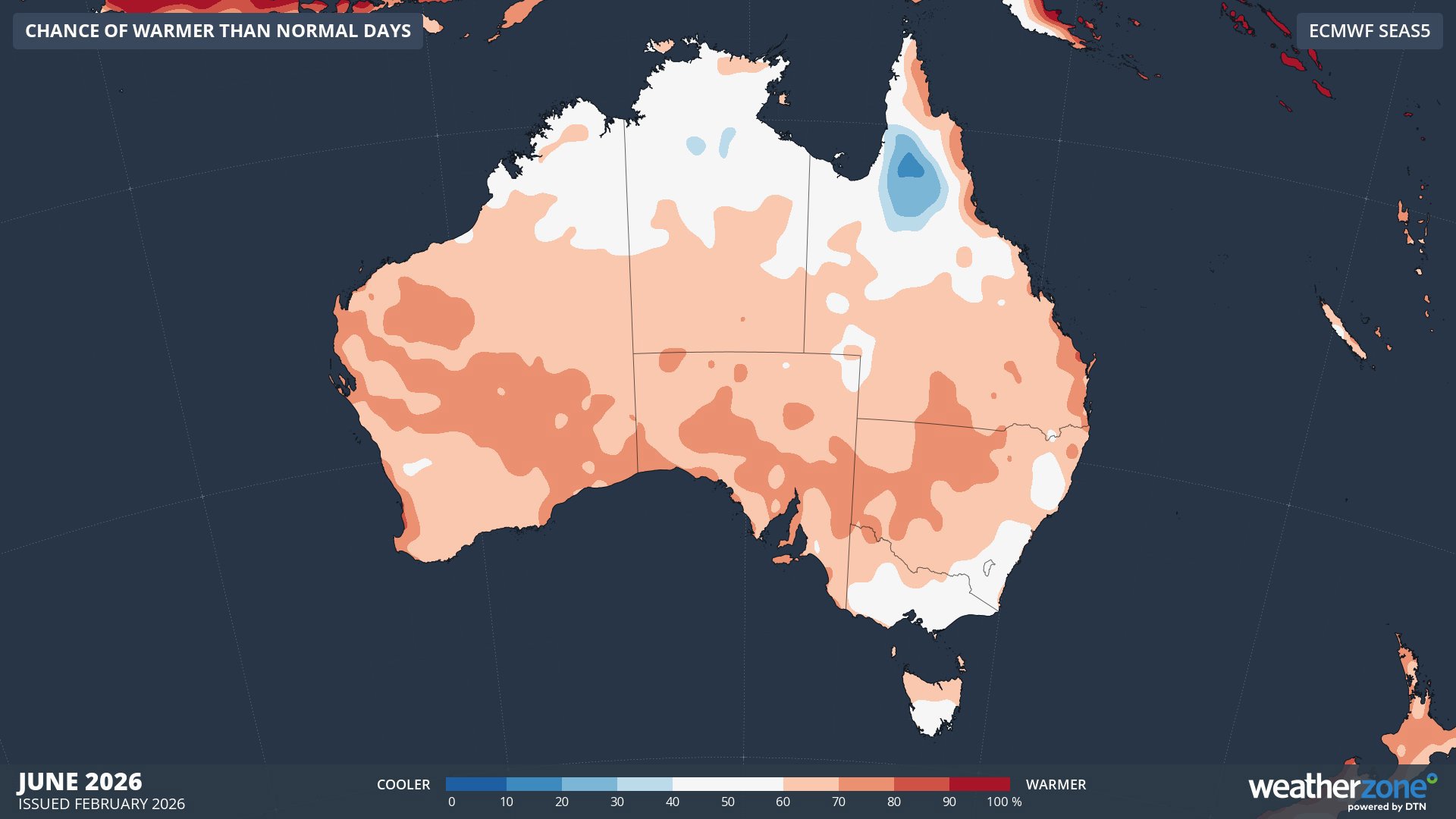
"While it's too early to know whether El Niño or a positive IOD will develop later this year, there are early signs that these two climate drivers could tip the scales towards warmer and drier weather during the second half of 2026," Weatherzone said.
"Monthly temperature and precipitation forecasts from the European Centre for Medium-Range Weather Forecasts (ECMWF) are responding to this, hinting at abnormally warm and dry conditions over Australia during the upcoming winter."
NEVER MISS A STORY: Get your breaking news and exclusive stories first by following us across all platforms.
- Download the 9NEWS App here via Apple and Google Play
- Make 9News your preferred source on Google by ticking this box here
- Sign up to our breaking newsletter here
from 9News https://ift.tt/LGYjJUN
via IFTTT
Comments
Post a Comment